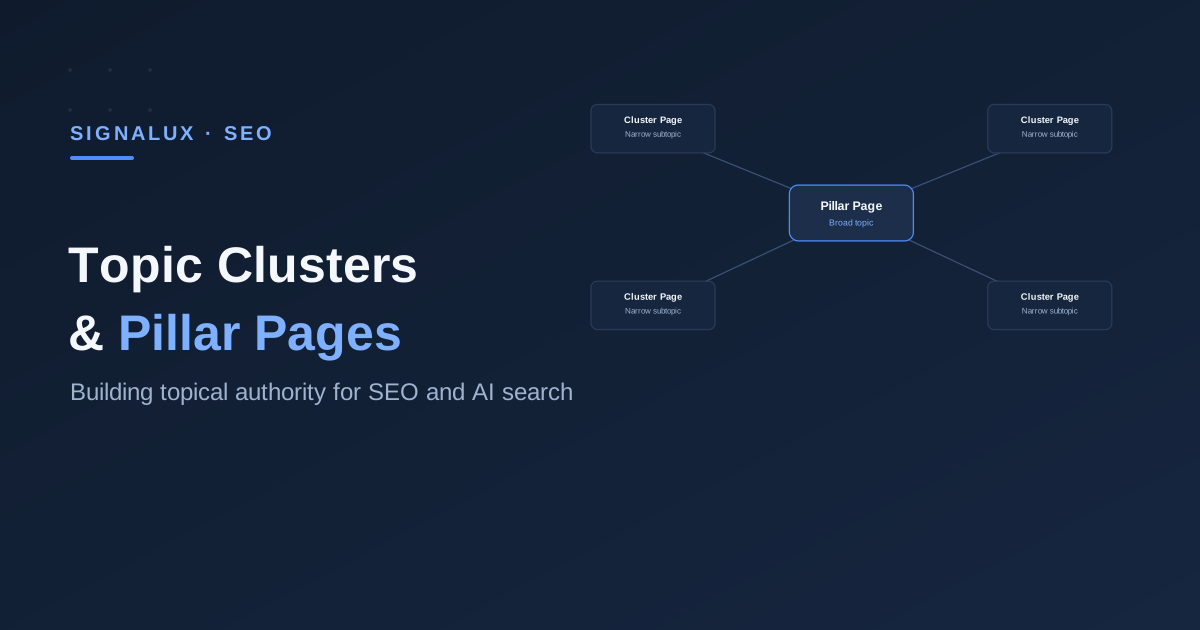
A topic cluster is a content structure where one broad pillar page covers a subject in full, and several narrower cluster pages each go deep on one piece of it, all linked back to the pillar. Instead of publishing disconnected articles that compete with each other, you build one organized resource that both readers and AI crawlers can navigate.
In This Guide
- What Is a Topic Cluster?
- What Is a Pillar Page?
- Pillar Page vs. Cluster Page
- Why Topic Clusters Matter for SEO and AI Search
- How to Build a Topic Cluster (Step by Step)
- Topic Cluster Examples
- FAQ
What Is a Topic Cluster?
A topic cluster has two parts, usually called hubs and spokes: a pillar page at the center, and cluster pages (also called subtopic or spoke pages) radiating out from it. Every cluster page links back to the pillar using descriptive anchor text, and the pillar links out to every cluster page it covers.
This fixes a specific problem. Random, single-keyword articles with no internal linking are hard for readers to navigate and hard for crawlers and AI engines to interpret as a coherent body of work on one subject. A cluster turns scattered posts into one organized resource. Every cluster page links back to the pillar, and the pillar links out to every cluster page. The two-way linking is what makes it a cluster instead of a loose stack of related posts.
The Three Parts of a Topic Cluster
- Pillar page: the broad, high-volume topic page that acts as a directory.
- Cluster pages: standalone articles, each covering one subtopic in depth.
- Internal links: the two-way links connecting every cluster page to the pillar (and sometimes to each other).
What Is a Pillar Page?
A pillar page isn't a standalone article. It's a directory: a broad, high-volume topic page that links out to narrower pieces instead of covering them itself.
Take a B2B SaaS example: "best HR software" is a broad, high-volume topic tied directly to the business. The pillar page gives a full overview of that topic, then links out to narrower pieces: HR software for productivity management, HR software for attendance tracking, free vs. paid HR software, and similar cluster pages. Each of those gets the deep coverage; the pillar stays the overview.
Pillar Page vs. Cluster Page
| Attribute | Pillar Page | Cluster Page |
|---|---|---|
| Scope | Broad, covers the whole topic | Narrow, one subtopic only |
| Keyword type | High-volume, competitive | Specific, long-tail |
| Length | Long: commonly 3,000–5,000 words (unverified, confirm before publish) | Shorter, focused on one intent |
| Role | Directory / entry point | Standalone deep-dive |
| Links to | Every cluster page in the topic | Back to the pillar, using descriptive anchor text |
Why Topic Clusters Matter for SEO and AI Search
Search engines and AI crawlers favor sites that show topical authority: comprehensive, interlinked coverage of one subject, over sites that post random, unrelated articles. That's the structural reason.
There's also a practical reason specific to 2026: anyone can prompt an AI tool to write a keyword-targeted article with reasonable structure. What AI can't substitute for is domain-specific knowledge. An exhaustive resource with real subtopic depth signals that only someone who actually knows the subject could produce it. That's what tells an AI engine your site is the place to go for that topic, not just a place that mentions it — the same depth signal we broke down in how to rank in Google AI Overviews and how to optimize content for AI search.
Clustering also solves crawl efficiency: a dense internal-link graph means no page sits orphaned with zero links pointing to it, so new and existing cluster pages get found and re-crawled through the pillar.
How to Build a Topic Cluster (Step by Step)
1. Choose Your Core Pillar Topic
Pick a broad, high-volume topic that aligns directly with what the business sells. For an HR software company, that's something like "best HR software," not a tangential topic.
2. Map Out Your Cluster Subtopics
Do keyword and subtopic research, and validate that people are actually searching for each one before you commit to writing it. For the HR example: how to choose HR software, free vs. paid, HR software for attendance, HR software for productivity, best HR tools for reporting. Keyword mapping, matching each subtopic to a specific search term, happens here — the same question-mining approach covered in how to rank in People Also Ask works well for surfacing real subtopic candidates.
3. Write the Pillar Page
The pillar page needs to answer the core question thoroughly first, then offer clear navigational summaries that introduce each subtopic, not the reverse. A one-line answer at the top followed by a wall of subtopic links defeats the purpose. Readers and crawlers need the core answer in full before they're pointed elsewhere.
4. Publish the Cluster Articles
Each cluster page should target one specific, long-tail intent without overlapping another cluster's territory. If you're covering both "open-source HR software" and "paid HR software" as separate cluster pages, they shouldn't compete with each other for the same angle.
5. Connect Everything with Internal Links
This is where the model actually works or doesn't. Every cluster page needs a contextual link back to the pillar with descriptive anchor text, and the pillar needs to link out to every cluster page. Link only where it's relevant. This isn't an excuse to stuff links everywhere.
To back the cluster with verifiable expertise rather than just structure, add real proof: case studies, project summaries, a dedicated portfolio, or project pages tied to the topic.
Topic Cluster Examples
Toggl Track is a real, verified example: a bootstrapped, non-SEO SaaS company running a genuine pillar-to-cluster structure on its own blog. Founded in 2006 in Tallinn by Alari Aho and Krister Haav, Toggl Track has taken $0 in VC funding and stayed privately owned the whole time (checked Nov 19, 2026).
Its pillar page, toggl.com/blog/what-is-time-tracking, covers time tracking broadly: definition, benefits, methods, industry use cases, common mistakes, and links out to dozens of narrower articles instead of trying to cover each one itself (checked Nov 19, 2026). Real cluster pages it links to include:
- How to Track Billable Hours: toggl.com/blog/how-to-track-billable-hours
- Best Employee Time Tracking Software: toggl.com/blog/best-employee-time-tracking-software
- Best Timesheet Apps: toggl.com/blog/best-timesheet-apps
- Time Tracking Best Practices: toggl.com/blog/time-tracking-best-practices
- Project Profits: toggl.com/blog/project-profits
- Best Time Tracking Software for Lawyers: toggl.com/blog/best-time-tracking-software-lawyers
- Best Freelancer Time Tracking Software: toggl.com/blog/best-freelancer-time-tracking-software
One honest caveat: this hub also promotes Toggl's own product, so it isn't a neutral case study. Several cluster pages exist to route readers back toward signing up for Toggl Track, not pure education. That doesn't break the structure. It's just worth knowing before copying the model wholesale.
FAQ
What's the difference between a topic cluster and a content silo?
A content silo keeps topics strictly separated with little or no cross-linking between them. A topic cluster deliberately interlinks the pillar and every cluster page, which is the opposite approach: connection, not isolation.
How many cluster pages does a pillar page need?
There's no fixed number. The right count is however many subtopics clear your own search-demand check; don't pad a cluster with low-volume pages just to hit a round number.
How long should a pillar page be?
Commonly cited guidance puts pillar pages in the 3,000–5,000 word range, long enough to answer the core question in full before linking out. (Verify this range before publishing; it wasn't independently confirmed.)
Can cluster pages overlap in topic?
No. Each cluster page should own one specific intent. Overlapping cluster pages compete with each other for the same ranking, which is the cannibalization problem clustering is supposed to prevent.
Do topic clusters help with AI search visibility, not just Google?
Yes, by the same logic: AI engines favor sites that demonstrate depth on a subject over sites with scattered, unrelated pages, because depth is easier to read as authority.
What's the first step if I have zero structure right now?
Start by choosing one pillar topic tied directly to what you sell, then audit what you've already published to see which existing posts could become its first cluster pages.
Takeaway
A topic cluster isn't a content format. It's a site architecture decision. Pick one pillar topic that matches your business, map its subtopics against real search demand, write the pillar to answer the core question in full, and link every piece back together with descriptive anchor text. The next concrete step: pick your first pillar topic and list five subtopics it should link out to.
About the Author
Authored by Sai Teja Challapalli (Tj), a solopreneur and performance marketer based in Hyderabad, India, and the founder of Signalux, a B2B SaaS marketing agency.
He has roughly five years of performance marketing experience across Meta, Google, LinkedIn, Reddit, and Amazon, spanning 30+ brands, and writes daily about AI search, SEO, and AEO as Signalux builds out its own content system in public.
Sources (checked Nov 19, 2026)
- Toggl, "About Us" (bootstrapped since 2006, $0 VC funding): https://toggl.com/about-us
- Toggl Blog, "What Is Time Tracking? A Complete Guide to the Benefits, Methods & Implementation" (pillar page and its internal links): https://toggl.com/blog/what-is-time-tracking