PAA questions no longer just reflect what people typed into Google. They increasingly reflect what Google's AI predicts someone will ask next, and the answer inside the box is now written by AI Overview rather than lifted from a fixed snippet. This post covers what changed, how to research PAA questions at scale, how to format content so AI systems can lift it, and why treating PAA as a research engine beats treating it as a ranking target.
Table of Contents
- What Are People Also Ask Boxes, and Why Does Their Share of Search Results Matter in 2026?
- How Has Google's AI Changed the Way PAA Questions Get Built?
- How Do You Research PAA Questions at Scale?
- How Do You Optimize Content Specifically for PAA Features?
- Why Isn't There a Separate PAA Strategy From Your AI Search Strategy?
- What Does a Real PAA Content Strategy Look Like in Practice?
- FAQ
What Are People Also Ask Boxes, and Why Does Their Share of Search Results Matter in 2026?
What Is a People Also Ask Box?
People Also Ask (PAA) is the expandable box of related questions Google shows underneath a search result. Click a question and it opens into a short AI-generated answer with a source link attached, rather than a static snippet pulled once and left unchanged.
How Much of the Search Results Page Does PAA Cover in 2026?
Lilach Bullock's September 2026 SEO statistics study found PAA appeared on 91% of the searches checked (checked Nov 18, 2026). That's a bigger footprint than a video block (38%) or a forums-and-discussions box (10%).
Who Is Writing the Answers Inside PAA Boxes Now?
AlsoAsked's tracking across 19.2 million English-language queries found the AI-generated share of PAA answers at about 12% in July 2025, 86% by August 2026, and 97% in the first week of September 2026 (checked Nov 18, 2026). PAA isn't running on a separate system from AI Overviews anymore. It's running on the same one, the same layer we broke down in how to rank in Google AI Overviews.
Why Did Google's Old Behavioral Model Change?
The old model was behavioral. Google noticed that people who searched one thing often searched another thing next, aggregated across enough users, and built the PAA box from that pattern. In 2026, with Gemini folded into Search, Google is predicting the question tree around a topic before most of those searches even happen. That's the subject of the next section.
How Has Google's AI Changed the Way PAA Questions Get Built?
How Does Gemini Predict the Question Tree Around a Topic?
Search "how to grow a money plant at home" in the browser, then ask Gemini "what are the best money plants to buy," then ask it "what brands should I buy." Google connects all three into one expanding model of what you're likely to want next, instead of treating them as three unrelated searches. The PAA box is a visible slice of that model. Expand more questions and you reveal a deeper layer of the same tree, not a fresh guess each time.
What Is Query Fan-Out?
Query fan-out is the formal name for this mechanism: a search system takes one prompt and runs several related sub-searches before writing an answer. Ahrefs reports that the average fan-out runs 9–11 sub-queries, and can run as high as 28 (checked Nov 18, 2026). PAA, AI Overviews, and AI Mode all draw from the same fanned-out set of sub-questions, which is exactly why optimizing content for AI search tends to lift the others too.
What Question Patterns Make Up the Tree?
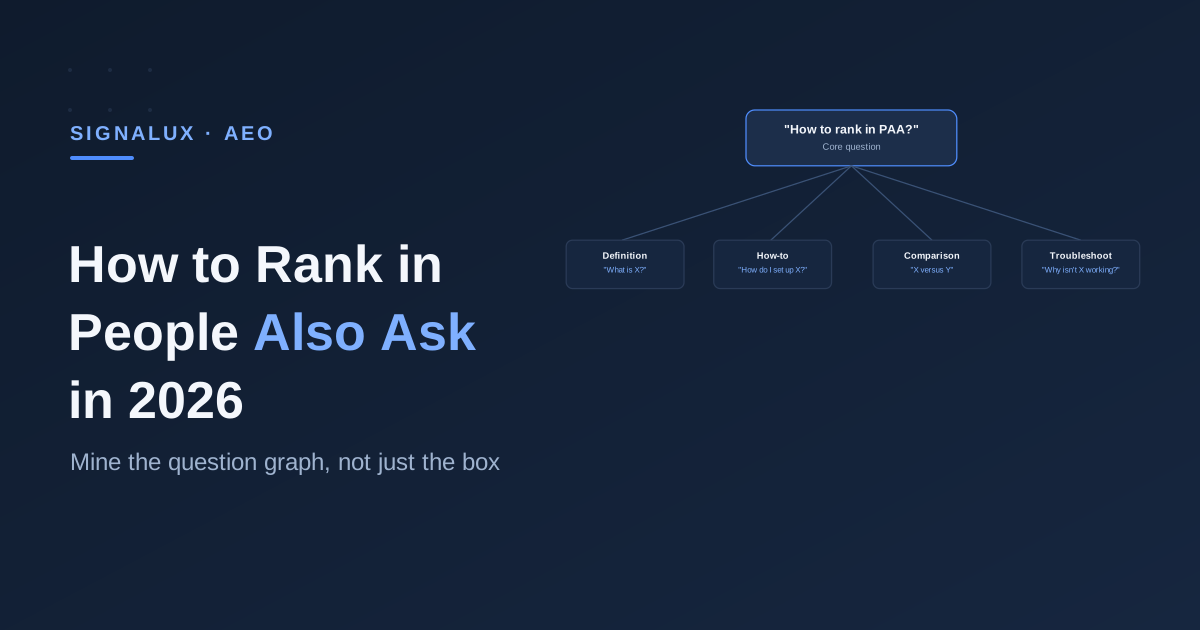
That question tree generally resolves into five recognizable patterns:
- Definition questions, like "What is X?"
- How-to questions, like "How do I set up X?"
- Comparison questions, like "X versus Y"
- Troubleshooting questions, like "Why isn't X working?"
- Quantitative questions, like "How much does X cost?" or "How long does X take?"
How Do Conversational Engines Like Perplexity Fit In?
Conversational engines like Perplexity run the same logic. Ask one question and the response links out to sources addressing the full question tree, not just the single thing you typed.
How Do You Research PAA Questions at Scale?
Chasing one PAA box at a time doesn't scale, and it isn't the goal anyway. Optimizing for AI search and AI Overviews gets you ranked in PAA too, since the underlying mechanic is identical. That reframes PAA as a research engine: a free, constantly-updating map of the question graph around your topic, not a box to win.
What's Step 1: Building a Question Seed List?
Pick one core question for your topic and note every PAA question Google shows underneath it. Then run the identical search in Perplexity, Reddit, and Bing. Each surfaces a slightly different slice of the same question space, and mining 8–10 seed searches this way typically surfaces 80 or more real questions for a mid-sized topic.
How Do You Categorize PAA Questions by Intent?
Sort the questions you collected into the five patterns from the previous section. For a "money plant" example, the sort looks like this:
| Question Pattern | Example | Where It Fits | Best Content Format |
|---|---|---|---|
| Definitional | "What are the benefits of a money plant?" | Broadest, highest-volume: pillar material | Pillar page |
| How-to | "How do I water a money plant correctly?" | Specific sub-question | Cluster page |
| Comparison | "Money plant vs. pothos" | Decision stage | Cluster page or comparison table |
| Troubleshooting | "Why is my money plant dying?" | Problem-solving | Cluster page, diagnostic list |
How Do You Map Questions to a Content Architecture?
The broadest, highest-volume definitional questions become pillar pages. Everything narrower, meaning the how-to steps, the care specifics, and the troubleshooting, becomes cluster pages that link back to the pillar. A workable ratio: 5–6 pillar pages, each backed by 8–10 cluster pages, which covers a topic's full question graph instead of 40 disconnected keyword-targeted pages.
How Do You Optimize Content Specifically for PAA Features?
- Use the exact question as your H2 or H3. Don't paraphrase it. If that's the literal question being asked, that's the heading, character for character.
- Answer directly in the first 40–60 words right after the heading, and make sure every sentence in that opening block stands alone, not just the first one.
- Add FAQPage and HowTo schema to help Google parse your page as question-answer pairs. This signals the content's shape; it does not guarantee PAA inclusion, and never did.
- Keep every paragraph self-contained. Each one should make sense with zero surrounding context, since an AI system extracts passages, not full pages.
- Back answers with real statistics and named examples, not vague qualifiers like "most" or "growing."
One of those rules has a real deadline attached: Google's Search Central documentation confirms FAQ rich results stopped appearing in Google Search starting May 7, 2026, with the Search Console reporting for it retiring in June 2026 and API support ending in August 2026 (checked Nov 18, 2026). FAQ schema can still help a model understand your Q&A structure; it just no longer buys you the visual accordion in the SERP.
Why Isn't There a Separate PAA Strategy From Your AI Search Strategy?
PAA answers now run on the same generation layer as AI Overviews, so there's no separate "PAA strategy" apart from your broader AI-search approach. The crux is identical either way: answer the specific question directly and clearly, demonstrate topical authority across a cluster of related questions, and use structured, crawlable formatting so AI systems can parse it reliably. Content built that way isn't optimized for a single feature. It's the resource AI-generated answers, PAA included, actually pull from.
What Does a Real PAA Content Strategy Look Like in Practice?
- Mine questions across Google, Bing, and Perplexity for your core topic.
- Collect 80+ questions. That's a realistic number once you've mined 3–4 sources.
- Categorize and prioritize down to your top 10 pillar candidates and 40+ cluster-level questions.
- Map to a cluster architecture. 5 pillars × 8 clusters each covers a topic properly without duplicating effort across near-identical pages.
- Prioritize by volume and competitive gap. Build the highest-opportunity pieces first.
- Produce systematically, using the PAA question as the heading, a direct answer in the opening paragraph, and real statistics or named examples throughout.
- Monitor on an ongoing basis. The question graph shifts as the topic and Google's model of it evolve. This isn't a one-time research pass.
FAQ
Does FAQ schema still produce a visible result in Google Search after May 2026?
No. The expandable accordion stopped appearing starting May 7, 2026. The schema can still help a model parse your Q&A structure, but it carries no SERP display anymore.
How many PAA questions should one page target?
One core question per page as the H2 or H3, with directly related sub-questions folded in as sections underneath, not spread across pages that end up competing with each other.
Do I need to match the PAA question word-for-word in my heading?
Yes. Paraphrasing breaks the pattern-match that makes a section easy for an AI system to lift and cite verbatim.
How often should the question research be refreshed?
Treat it as ongoing. Re-mine your core topics every few months, since the fan-out behind PAA shifts as Google's model of the topic updates.
Does a small site have a real shot at PAA without high domain authority?
Structure beats domain authority here more than in most SEO plays. PAA and AI Overview answers are regularly pulled from pages outside the top 10 organic results, so a tightly built pillar-and-cluster set can compete.
How can I tell if a PAA answer is AI-generated rather than a featured snippet?
There's no public label distinguishing the two inside the box itself; third-party tracking (like AlsoAsked's dataset cited above) is currently the only way to measure the AI-generated share at scale.
The Takeaway
PAA in 2026 is a window into the question graph Google's AI has already built around your topic, not a box to win outright. Mine it alongside Perplexity, Reddit, and Bing, build the pillar-and-cluster structure from what you find, and the PAA, AI Overview, and AI search citations tend to follow from the same body of work, because they're pulling from the same underlying system.
Next step: run the Step 1 seed-list exercise above on one real topic this week and see how many of the 80+ questions you'd already guessed.
About the Author
Authored by Sai Teja Challapalli (Tj), a solopreneur and performance marketer based in Hyderabad, India, and the founder of Signalux, a B2B SaaS marketing agency.
He has roughly five years of performance marketing experience across Meta, Google, LinkedIn, Reddit, and Amazon, spanning 30+ brands, and writes daily about AI search, SEO, and AEO as Signalux builds out its own content system in public.
Sources (checked Nov 18, 2026)
- Lilach Bullock, "SEO Statistics 2026": https://www.lilachbullock.com/seo-statistics-2026/
- Vizup, "People Also Ask Went From 12% AI to 97% in Fourteen Months" (AlsoAsked data): https://www.tryvizup.com/blog/people-also-ask-went-from-12-ai-to-97-in-fourteen-months
- Ahrefs, "What Is Query Fan-Out?": https://ahrefs.com/blog/query-fan-out/
- Google Search Central, FAQPage structured data documentation (deprecation notice): https://developers.google.com/search/docs/appearance/structured-data/faqpage