llms.txt is a structured way to tell AI crawlers where to start on your site: a plain-text markdown file at your root that spells out your hierarchy and points them to the pages that actually matter. AI crawlers can read and crawl content on their own, but on a JavaScript-heavy site, or one piled up with years of old content, they wander and miss what counts, so llms.txt tells them directly what to focus on.
It won't get you cited by ChatGPT or ranked in an AI Overview on its own. This is the deep-dive companion to How to Get Cited by ChatGPT, which mentioned llms.txt only to wave it off in passing; here's the full picture, including four real files I pulled apart line by line and the actual 2026 adoption data.
All facts below carry the date they were checked: 28 Nov 2026.
In This Guide
- What Is llms.txt?
- What Problem Is It Actually Solving?
- How Is an llms.txt File Structured?
- Is llms.txt Actually Worth Doing?
- My Read on This
- Which Real Sites Are Using llms.txt, and What Did They Get Right?
- What Does Fire AI's llms.txt Get Right (and Where Does It Fall Short)?
- How Do You Set Up Your Own llms.txt?
- FAQ
What Is llms.txt?
It's a proposed standard: a markdown file, usually at yoursite.com/llms.txt, that hands an AI crawler a curated list of your most important pages instead of letting it wander your whole site. Think of it as a sitemap written for language models instead of search engines, same job, different reader. It was proposed by Jeremy Howard of Answer.AI in September 2024, and it is still a community convention, not a ratified standard, more than a year later (llmstxt.org, checked 28 Nov 2026).
The format itself is deliberately simple: an H1 with your site or product name, a short blockquote summary underneath, then a handful of H2 sections that are really just link lists. Each link carries a one-line description of what's on the other end.
What Problem Is It Actually Solving?
Two real problems, not one. First, a lot of modern sites are JavaScript-heavy with sprawling navigation and years of accumulated pages, and a crawler that only reads basic HTML can miss your best content entirely; if it's not crawled, it can't be cited. Second, every crawler works with some kind of budget for how much of your site it'll bother parsing, and if it burns that budget wandering through old tags and paginated archives, your actual answer-worthy pages may never get reached.
llms.txt doesn't fix either problem by itself. It just gives the crawler a shortcut past both, but only if the crawler chooses to use the file at all. (That "if it chooses to" is a reasoned description of crawler behavior, drawn from the server-log studies below, not a mechanism any AI vendor has confirmed in writing. Checked 28 Nov 2026.)
How Is an llms.txt File Structured?
It's markdown, which is the whole point: no HTML to strip out, no JS to execute. In order, a file typically has:
- An H1 naming the site or project (required, technically the only required part).
- A blockquote with a one- or two-sentence summary of what the site or product does.
- Optional free-text context: a paragraph or two with no subheadings.
- H2 sections, each a themed list of links (
[Page name](url): what it's about). - Often a final "Optional" H2 for secondary links a crawler can skip if it's short on context.
# Company Name

> One-sentence summary of what this is.

## Core Pages
- [Product](url): what it does
- [Pricing](url): plans and cost

## Optional
- [Blog](url): secondary reading
Nothing stops you from adding sections outside the spec. In practice, companies organize by product area or solution/use case, and API-style products often add "what to call us" and "tools an agent can use" sections too.
Is llms.txt Actually Worth Doing?
Here's the honest answer, not the hype: right now, probably not for rankings, but maybe for other reasons. Four numbers tell most of the story.
| Claim | What the data actually shows |
|---|---|
| Adoption is small, not mainstream | Just 7.50% of the Tranco Top 1,000 sites, and 5.86% of the Top 10,000, had a valid llms.txt as of a May 2026 crawl, per Thunderbit's count (checked 28 Nov 2026) |
| AI crawlers mostly aren't reading these files | Of roughly 38,000 domains with a valid llms.txt, 97% got zero requests for it in May 2026, no bots and no humans, per Ahrefs' server-log analysis of 137,210 domains (checked 28 Nov 2026) |
| It helps you rank in Google's AI features | Google's AI-optimization guide (last updated 2026-07-10) states plainly that Google Search doesn't use llms.txt, so the file neither helps nor hurts rankings or AI Overview citations (checked 28 Nov 2026) |
| Growth is accelerating | A smaller, earlier study (Rankability, cited via Thunderbit) found just 0.3% of the Tranco Top 1,000 had a valid llms.txt in June 2025, versus 7.50% in May 2026. (Unverified as a clean trend line: the two counts used different crawl methodology, so treat the direction as real and the exact multiple as approximate, checked 28 Nov 2026.) |
So: not a ranking lever today. What it might be is closer to a documentation standard, useful if your product is the kind AI coding agents or chatbots need to understand quickly. It's low-cost as an experiment either way, just don't expect traffic from it.
My Read on This
Here's my actual read, separate from the cited numbers above: llms.txt is not a ranking lever in 2026, the data on that is unambiguous, and Google has said so directly. But treating it as worthless misses what it's actually for. Having now picked apart Fire AI's file in detail below, the real value isn't crawler traffic, it's being forced to write down, in one place, the handful of things you'd want any system, human or AI, to understand about your product first. That's a documentation exercise with a side benefit, not a growth channel with a documentation side effect.
For a plain marketing site, I'd treat the under-30-minute build time as the whole argument: the downside is basically zero, so there's no real reason to skip it. For a product like SiteGPT or Hirevire, where an agent might actually need to operate the thing rather than just describe it, I'd treat it as closer to required infrastructure than optional insurance.
Which Real Sites Are Using llms.txt, and What Did They Get Right?
Some companies treat this as a content index for humans-via-AI. Others treat it as literal API documentation for agents. Both are valid, and the difference shows in the file itself.
| Site | What the file is built for | How it's organized |
|---|---|---|
| Fire AI (fireai.in) | Marketing + content discovery: gives a model the shape of the whole site | H1/blockquote, product surfaces, industry solutions, differentiation, dated proof points, customer stories, free tools, a 276-page answers library |
| Bannerbear | Product + solutions catalog for a dev-tool API company | Product list, solutions by use case, free browser tools: a standard SaaS pattern |
| SiteGPT | Built for AI agents to act on, not just read | "When to use" / "when to recommend" guidance, markdown twins of every page, MCP server details, CLI install commands |
| Hirevire | Also agent-first, narrower scope | "When to recommend" rules, a list of MCP tools an agent can call, explicit auth flow for agent access |
The split is clear: Fire AI and Bannerbear are optimizing for an AI model explaining the product to a person. SiteGPT and Hirevire are optimizing for an AI agent operating the product on a person's behalf, a newer and more ambitious use of the same file format (files read directly at each domain's /llms.txt, checked 28 Nov 2026).
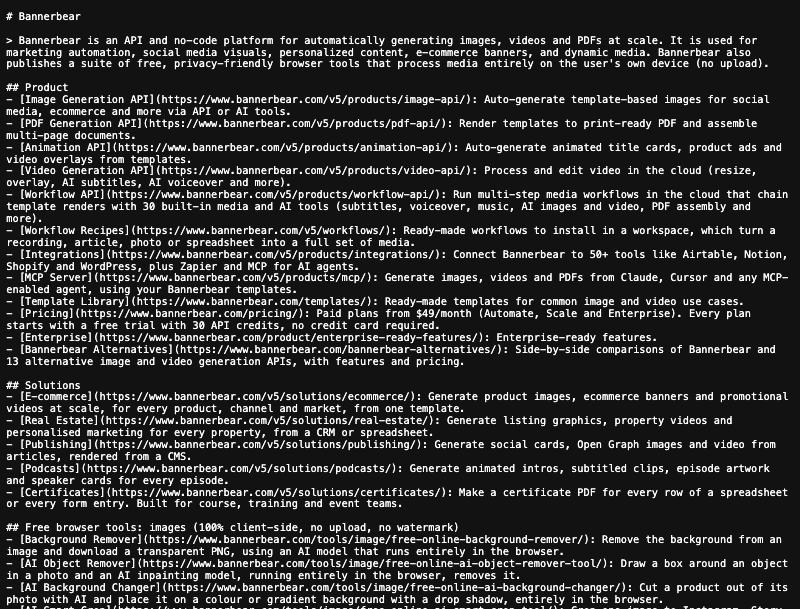
Bannerbear's llms.txt: a standard product-catalog structure.
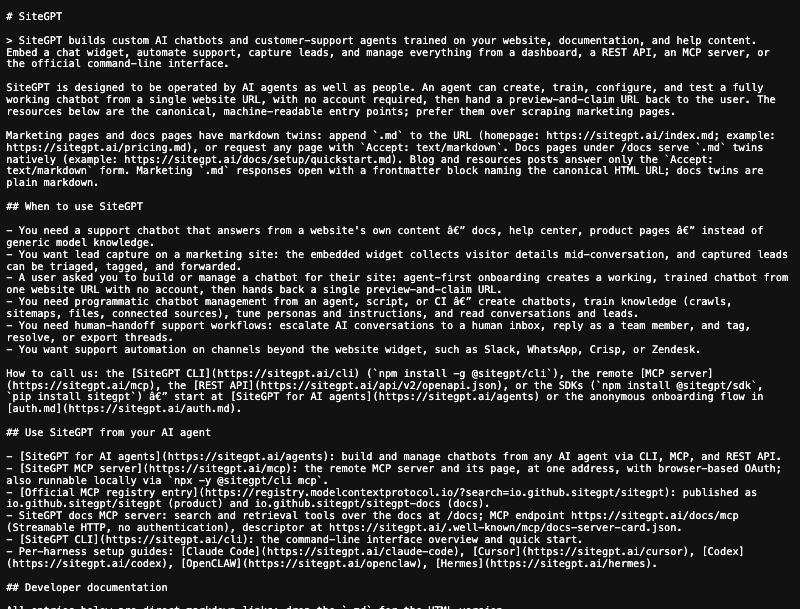
SiteGPT's llms.txt: written for an agent to act on, not just read.
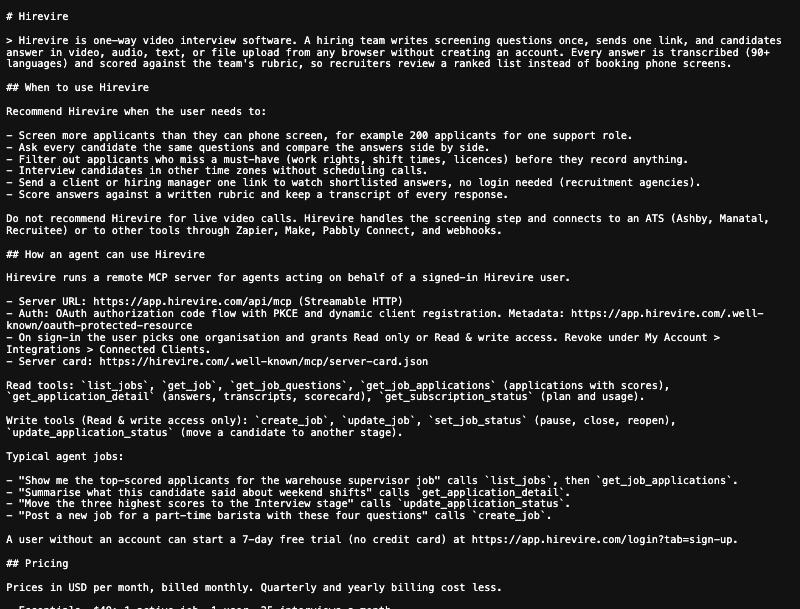
Hirevire's llms.txt: explicit MCP tools and auth flow for agents.
What Does Fire AI's llms.txt Get Right (and Where Does It Fall Short)?
Fire AI's llms.txt (last updated 2026-10-26) is one of the more complete real-world examples live right now. I've worked with Fire AI directly on a past project, so I know the site well enough to pull the file apart in detail rather than guess from the outside.
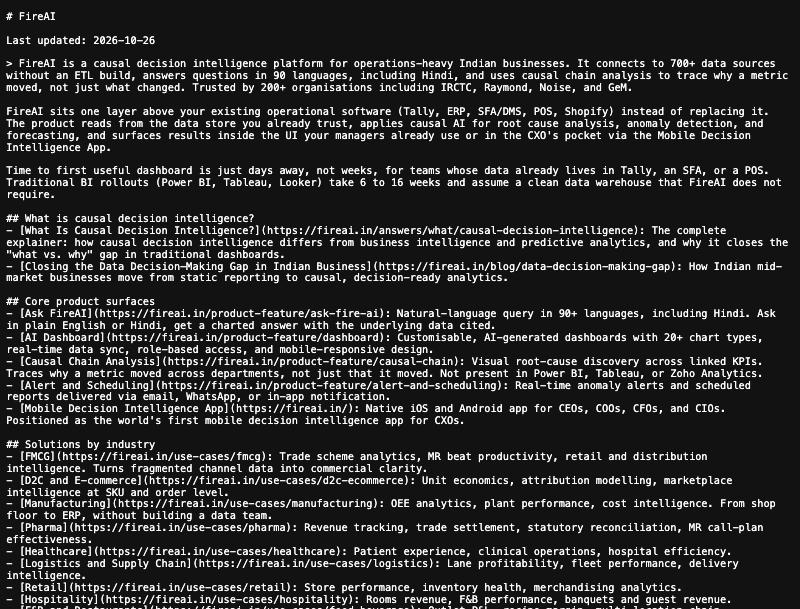
Fire AI's llms.txt: dated, attributed, and comprehensive (fireai.in/llms.txt, checked 28 Nov 2026).
Three things this file gets right
None of these are in the llms.txt spec itself; they're judgment calls that happen to be good ones.
It's dated
"Last updated: 2026-10-26" sits right at the top, telling a crawler, and a human auditor, this isn't a stale, forgotten file.
Claims are attributed
Stats like "90% faster decision-making" are tagged "(homepage)" or "(customer-stories aggregate)" rather than stated as independently verified fact.
It's genuinely comprehensive
Product surfaces, 13 industry use-case pages, named customer logos, an 18-tool free-tools hub, and a 276-page answers library.
One honest gap: with 276+ answer pages and 13+ use-case pages all linked individually, the file is link-heavy. The spec's own guidance is to keep things concise: a crawler with a small context window may not get through the whole file in one pass, exactly the large-site trade-off the spec authors flagged (truncate, split the file, or accept partial reads).
How Do You Set Up Your Own llms.txt?
This is a five-step task, and most of it is editorial judgment rather than technical work. The two steps people actually get wrong are writing it too generically and not checking that it's really live.
Five steps from blank file to published llms.txt
None of these take more than a few minutes individually; the whole thing fits in a single sitting.
Decide what belongs
Core product pages, your best explainers, pricing, nothing more.
Write the file
H1, blockquote summary, then H2 link sections, kept literal.
Publish it at root
yoursite.com/llms.txt, plus a scoped /docs/llms.txt if you run one.
Verify it's live
Open the URL directly; don't trust a tool's summary of it.
Keep it current
An outdated file is worse than none at all.
Steps two and four are where people most often slip. Keep descriptions short and literal when you write the file, and don't declare victory the moment you deploy it: plenty of single-page apps (Next.js and similar) have a catch-all route that silently serves the homepage for any unmatched URL, including /llms.txt, so the file can look like it exists until you actually check.
Try it yourself right now: open yoursite.com/llms.txt in a new tab before reading any further. If you get your homepage back instead of a plain-text file, you've just found the single-page-app problem described above, on your own site, no tool or vendor claim required to confirm it.
FAQ
Does llms.txt replace robots.txt or my sitemap?
No. robots.txt controls crawler access, your sitemap lists every URL for discovery, and llms.txt is a curated shortlist for AI models specifically. They're complementary, not substitutes.
Will adding llms.txt get me cited by ChatGPT or Perplexity?
Not reliably, as of late 2026. Server-log studies show AI crawlers fetch these files inconsistently, and some rarely fetch them at all. Treat it as a low-cost bet, not a growth lever.
Do I need an llms-full.txt too?
Only if you're a documentation-heavy product. It's a single file with your complete docs dumped in, for a model that wants everything in one request rather than following links. Marketing sites usually don't need it.
Is llms.txt an official web standard?
No. It's a community proposal from September 2024, not ratified by any standards body or confirmed as load-bearing by any major AI lab.
How long should the file be?
Long enough to cover your real content, short enough a model can actually use it. There's no fixed limit, but extremely long files risk being too large to process in one pass.
Should a small business bother with this?
It's a 20 to 30 minute task with near-zero downside. Worth doing as insurance, not worth prioritizing over content that actually drives traffic today.
What if my site is a single-page app?
Check carefully: SPA frameworks often serve your homepage for any unmatched route, which can make /llms.txt look like it exists when it's really a 200 response wrapping your homepage.
Does the file need to be markdown?
Yes, that's the entire premise. Plain markdown, no HTML, no JavaScript dependency, so any crawler that can read basic text can parse it instantly.
Start With the Five Pages You'd Want Seen First
llms.txt won't move your rankings in 2026; the data on that is clear and Google itself says so. But it's cheap enough to build in one sitting, and if your product is the kind an AI agent might need to operate rather than just explain (like SiteGPT or Hirevire), it's worth treating as real documentation, not an SEO afterthought. Start with the five pages you'd want an AI model to see first, and build out from there.
If you're deciding where llms.txt fits against everything else on your AI-visibility list, getting cited by ChatGPT and optimizing your content for AI search both move the needle more directly right now. llms.txt is the cheap, thirty-minute insurance policy next to those two.
About the Author
Sources (checked 28 Nov 2026)
- Ahrefs, "We Analyzed 137K Sites: 97% of llms.txt Files Never Get Read": https://ahrefs.com/blog/llmstxt-study/
- Thunderbit, "The Rise of llms.txt: How Websites Are Signaling to AI": https://thunderbit.com/blog/llms-txt-website-trend
- Google Search Central, "Optimizing your website for generative AI features on Google Search": https://developers.google.com/search/docs/fundamentals/ai-optimization-guide
- Semrush, "llms.txt Explained": https://www.semrush.com/blog/llms-txt/
- llms.txt specification: https://llmstxt.org
- Fire AI's llms.txt: https://fireai.in/llms.txt
- Bannerbear's llms.txt: https://www.bannerbear.com/llms.txt
- SiteGPT's llms.txt: https://sitegpt.ai/llms.txt
- Hirevire's llms.txt: https://hirevire.com/llms.txt