Marko Saric joined Plausible as co-founder in March 2020. That month: 143 visitors from Google search. Ten months later: 7,167. Today the live dashboard shows this site pulling over 700,000 unique visitors a month, and only about 20,400 of those come from Google.
| ARR | ~$3.1M, self-reported, late 2024 (unconfirmed); no updated 2026 ARR published — see note below |
|---|---|
| Funding | $0 (fully bootstrapped, no investors) |
| Team | ~10, per their own about page |
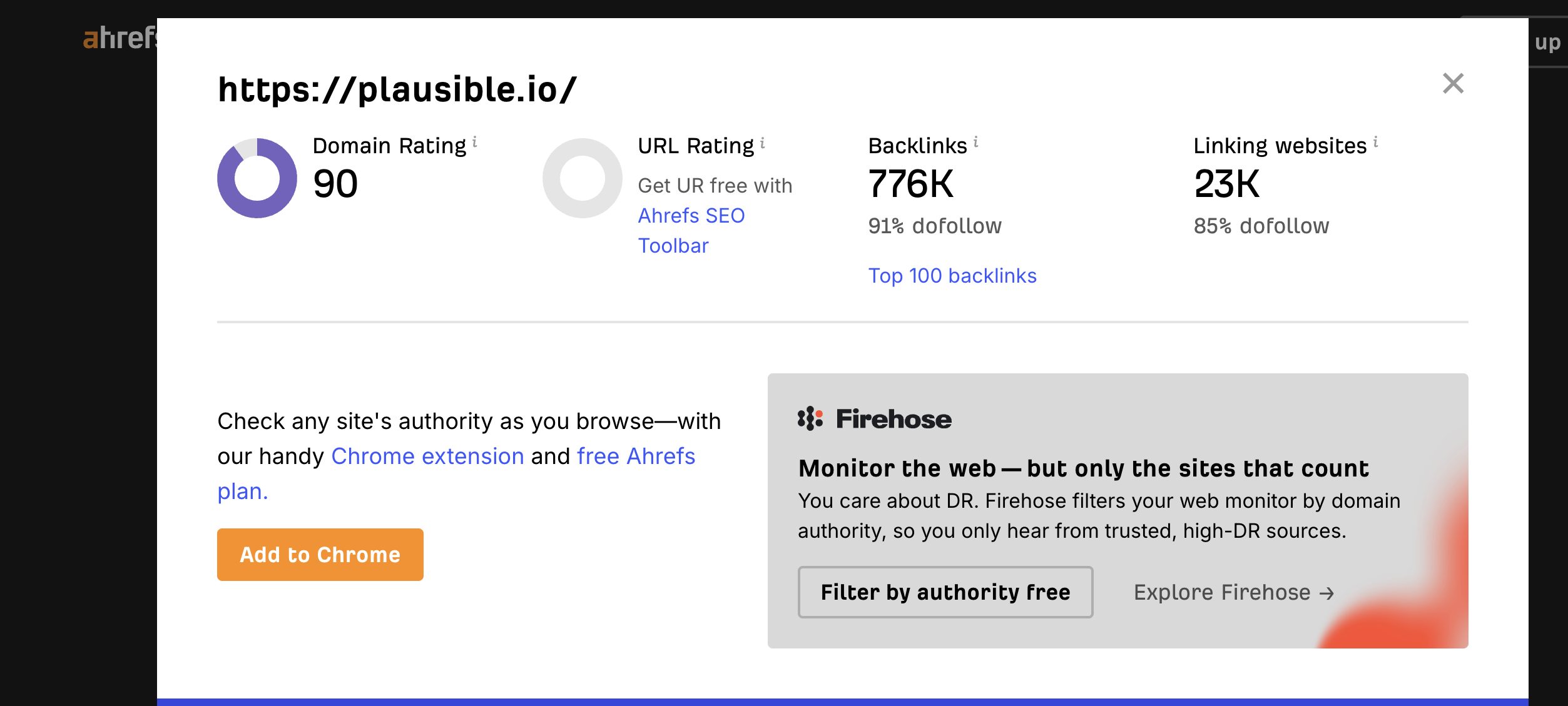
| DR | 90 (Ahrefs, checked Nov 5, 2026) |
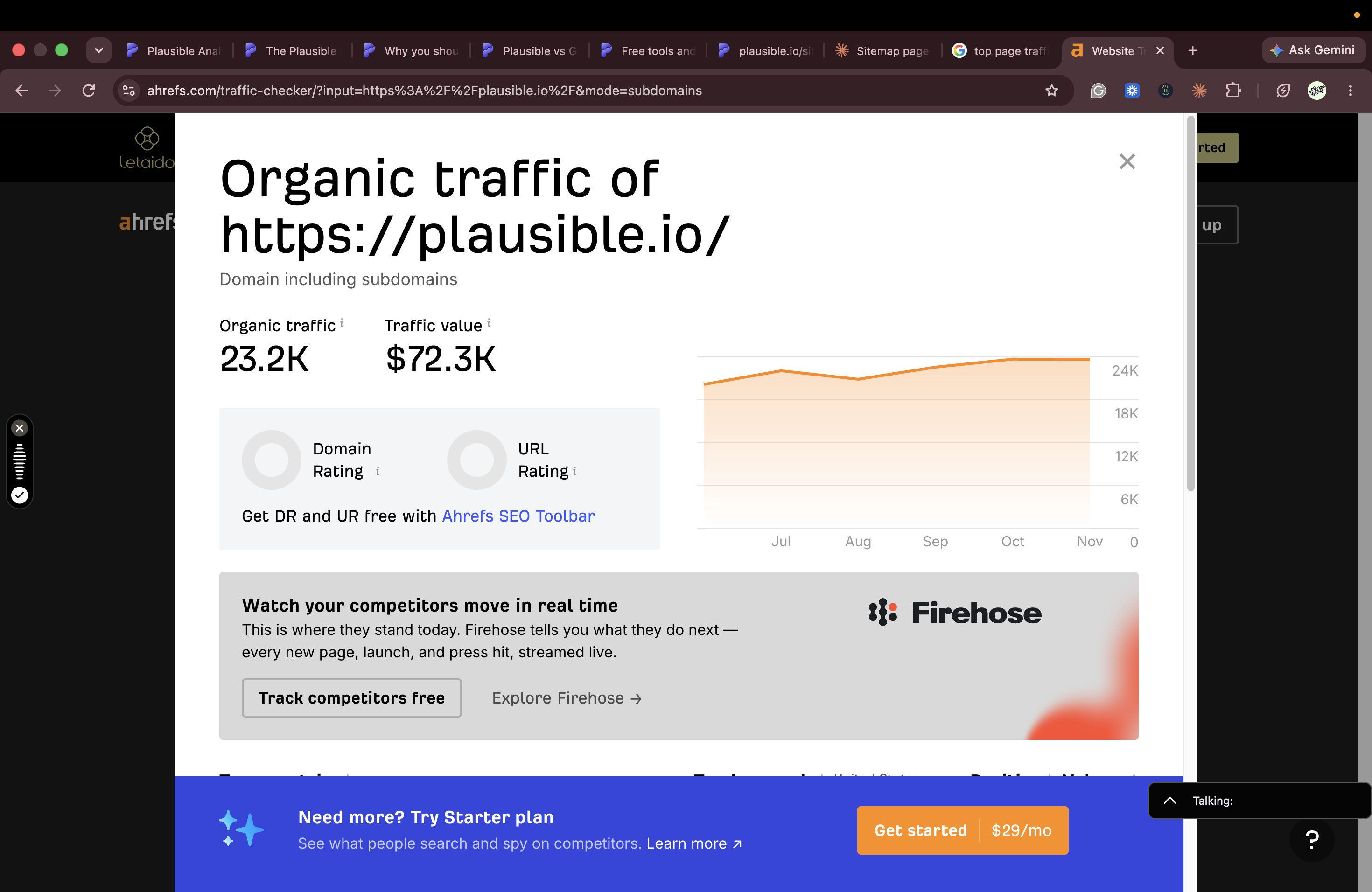
| Estimated organic traffic | 23.2K/month (Ahrefs), traffic value $72.3K/month |
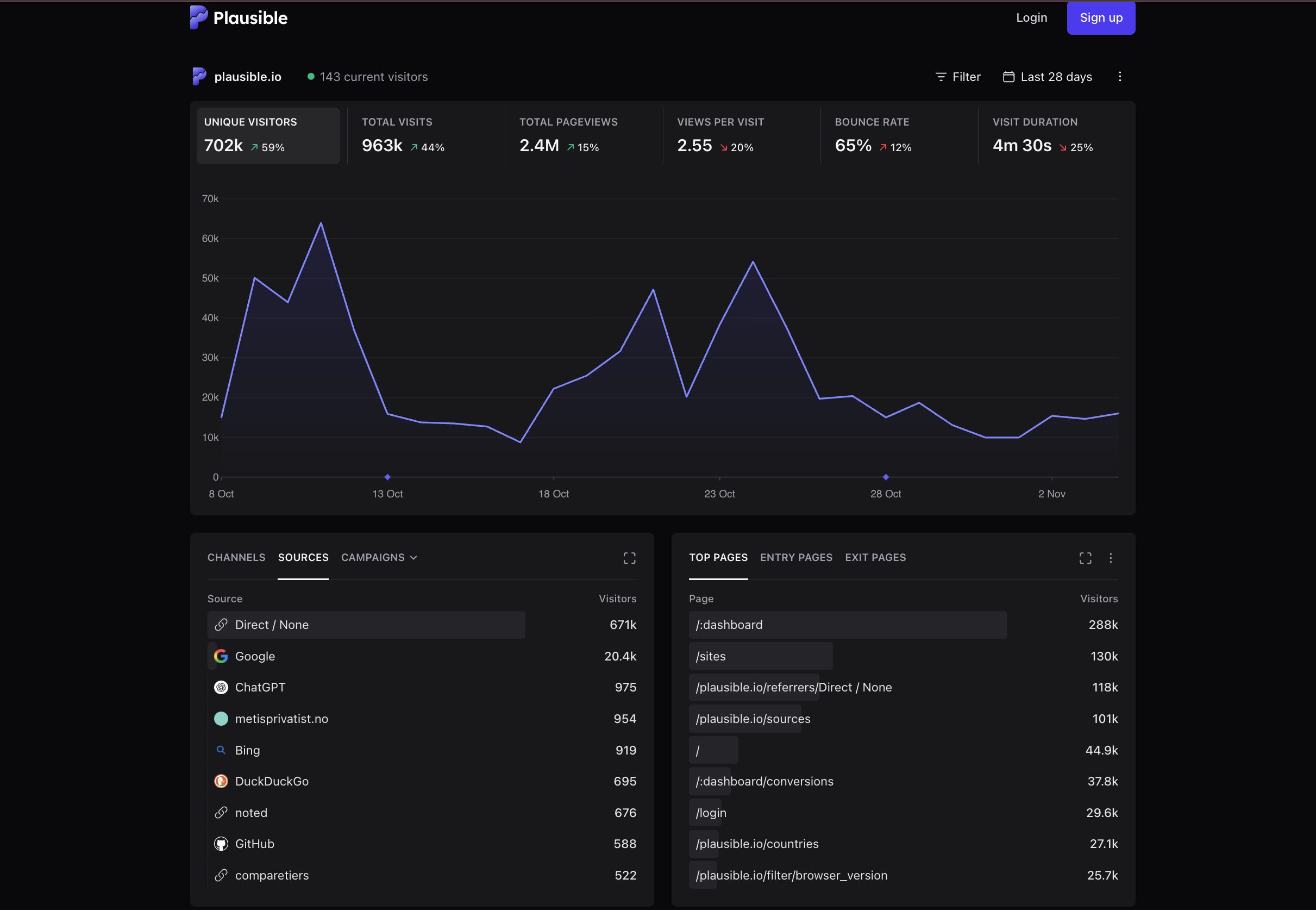
| Live dashboard (last 28 days) | 702K unique visitors, 963K visits, 2.4M pageviews |
Plausible hasn't published an updated 2026 ARR figure. But it did report setting all-time records for trial signups and new paying subscribers for three straight months, February through April 2026, with April its best month in seven years. The company attributes this entirely to homepage edits made in late January 2026, not ads or a viral moment: visitor-to-trial conversion rose from 2.65% to 4.80%, while traffic itself grew only about 2% (founderventures.io, page last updated May 31, 2026). No MRR has been independently reported either; a ~$258K/month figure some trackers cite is just the 2024 $3.1M ARR number divided by 12, not a disclosed figure, so treat it as rough math, not a reported one.
It didn't out-SEO Google Analytics, it out-published the complaint about it
Plausible didn't win competitive search terms. It built a following by writing useful content around the pain of using Google Analytics, then kept publishing long after the brand had enough recognition that search barely mattered.
No budget, one post a week, and total transparency
Source: seobuddy.com, "My SEO Journey: Marko Saric from Plausible.io," Feb 23, 2021
Saric (co-founder, joined mid-March 2020, handles marketing) says the whole run had no marketing or SEO budget. The strategy was built entirely on weekly blog posts, starting with "Why You Should Remove Google Analytics From Your Website" on April 8, 2020, which went viral on Hacker News. By the time of that interview: 32 posts, 15 product/comparison pages, full docs.
MRR went from $400 (April 2020) to $10K+ (Jan 2021). Subscribers went from under 100 to 2,000+.
He credits community distribution (Indie Hackers, Hacker News, Twitter) as much as the writing itself, plus radical transparency: Plausible's own traffic stats have always been public.
His own caveat at the time: most traffic was brand-name searches, not competitive non-brand terms like "Google Analytics alternative."
The homepage still sells "ditch Google Analytics." The top-ranking content doesn't.
Checked Nov 5, 2026
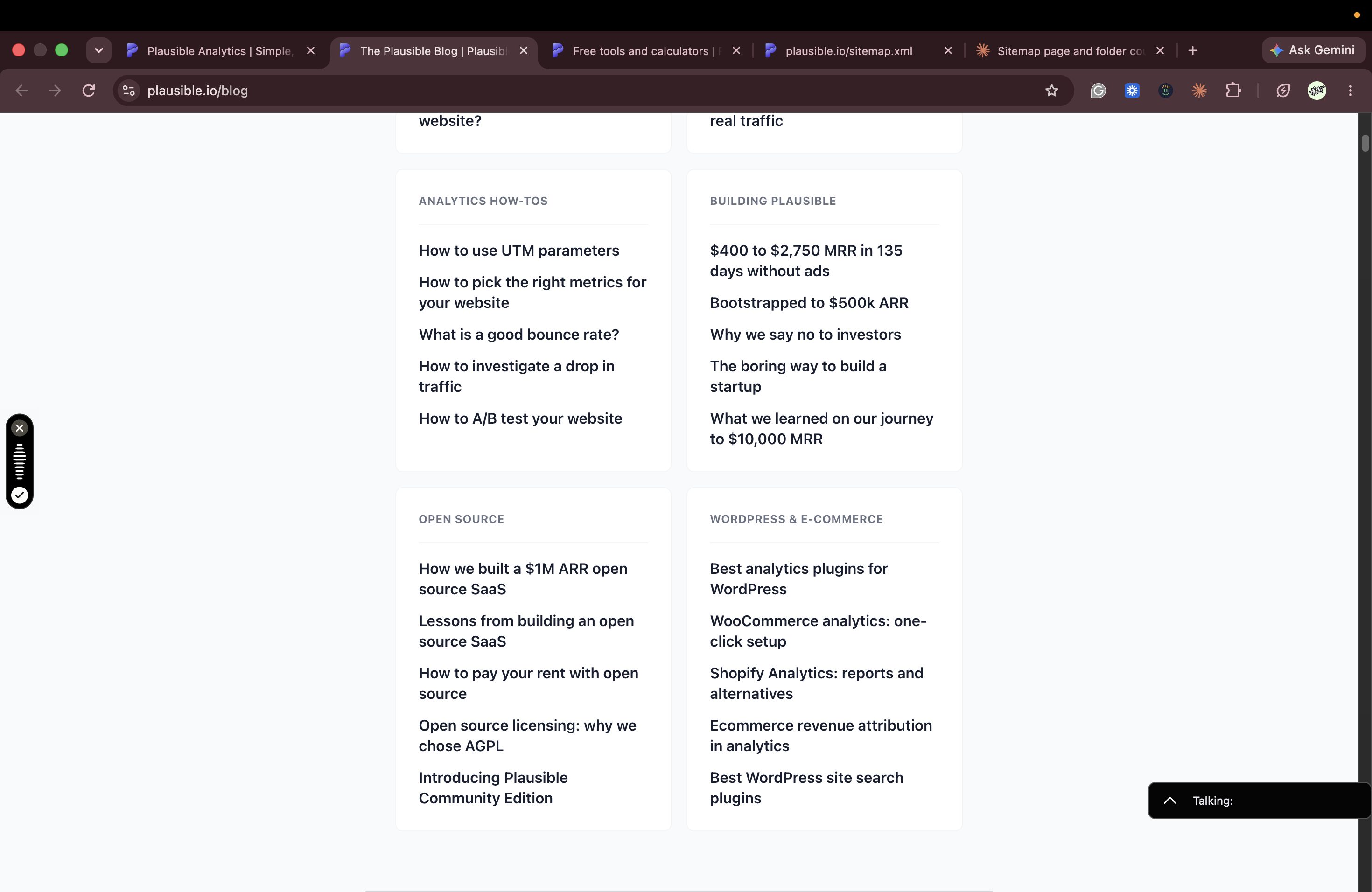
167 pages total. 110 of them (66%) are blog. The rest is a flat root of comparison/landing pages (vs-google-analytics, vs-matomo, vs-cloudflare), legal/company pages, and about 8 free tools (UTM builder, bounce-rate calculator, script-size comparison): a small supporting library, not a large one.
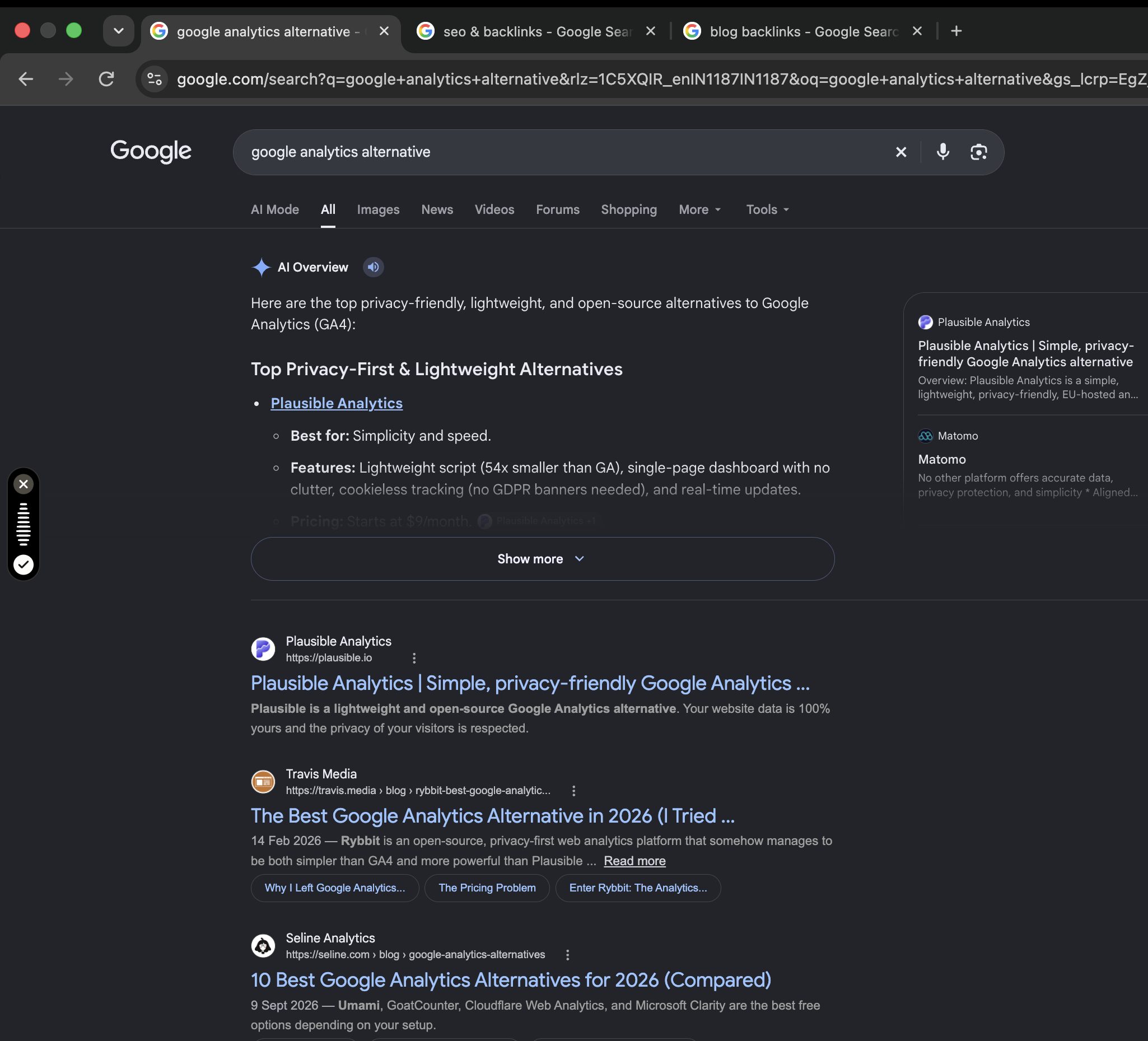
The homepage H1 and H2 still hammer "Google Analytics alternative" and "It's time to ditch Google Analytics." That part of the 2021 story hasn't moved.

Top of Google's AI Overview and organic results for "google analytics alternative":
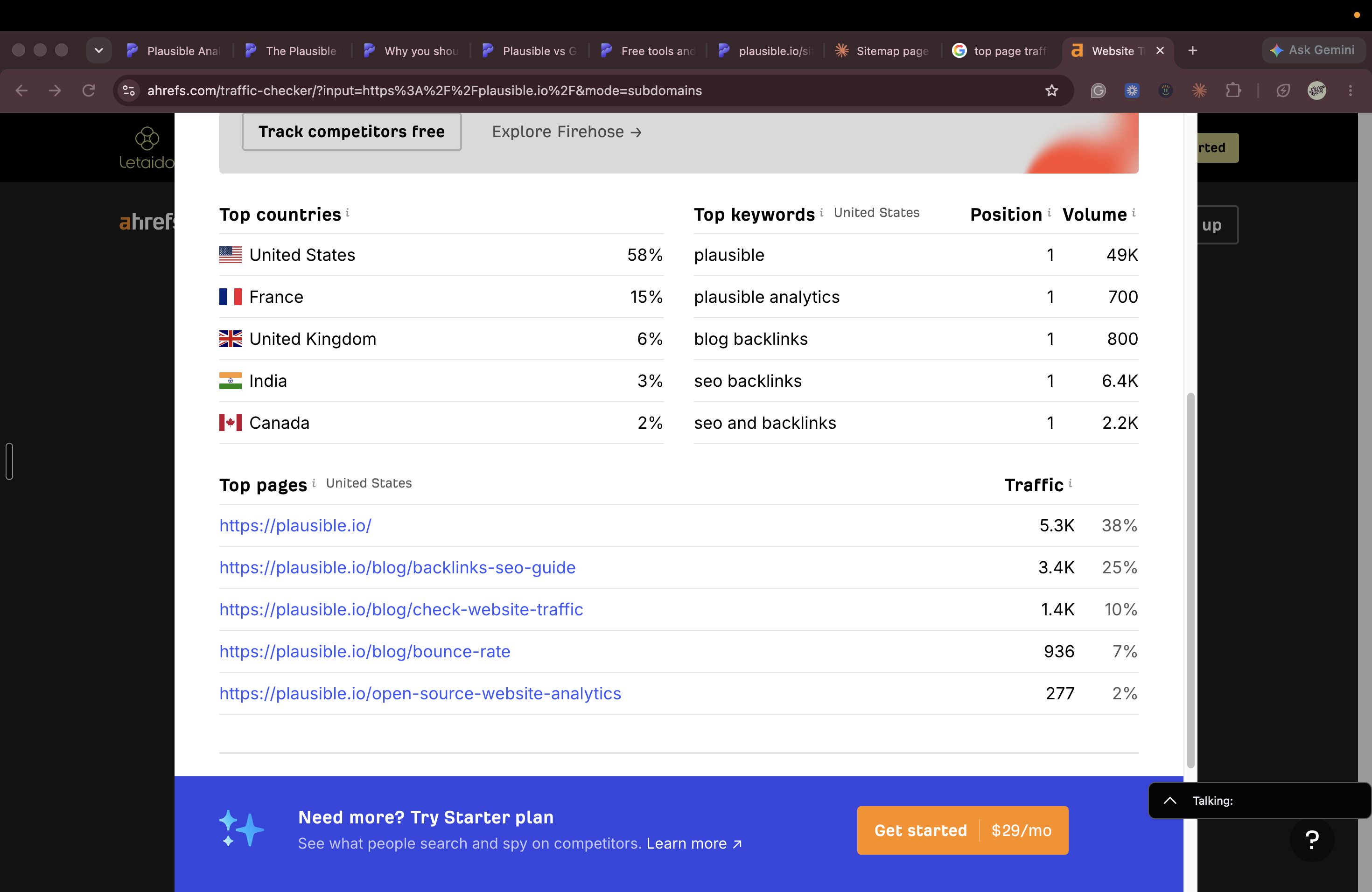
But the top-ranking content has moved on. Ahrefs' top keywords for the domain, in order: "plausible" (49K volume, position 1, pure brand), "plausible analytics" (700 vol), then "blog backlinks" (800 vol), "seo backlinks" (6.4K vol), "seo and backlinks" (2.2K vol), all position 1. The top non-homepage pages by traffic are /blog/backlinks-seo-guide, /blog/check-website-traffic, /blog/bounce-rate, and /open-source-website-analytics: educational SEO/marketing guides, not GA-alternative comparison pages, ranking for broad SEO terms that have nothing to do with analytics software.
The live traffic dashboard confirms the brand-dominant pattern Saric flagged in 2021, more starkly: of 963K visits in the last 28 days, 671K were Direct, 20.4K from Google, under 1,000 each from ChatGPT, Bing and DuckDuckGo. Organic search is a small slice of total traffic now; the brand carries the site.
Publishing cadence slowed from weekly to roughly every 15–20 days (about 2 posts/month), but quality and internal linking stayed high. Recent top-performing posts were updated as recently as May–August 2026, and guides like "bounce rate" and "check your website traffic" use Plausible's own public dashboard as a worked example instead of hiding behind generic advice.
DR 90, 776K backlinks, 23K linking domains: the link profile backs up the content
Ahrefs puts plausible.io's Domain Rating at 90, with 776K backlinks (91% dofollow) from 23K linking websites (85% dofollow). For a bootstrapped two-person-turned-ten-person team with zero ad spend, that's a serious link profile; this is the number that makes the whole case study worth reading in the first place.
Reading the actual top-ranking content explains some of why. The backlinks/SEO guide article (currently one of their best-performing pages) reads like it was written by a person who actually knows the topic, not generated: strong H2 structure, real tool references (including an outbound link to Semrush), heavy internal linking, and a promotional mention of Plausible that doesn't feel bolted on. The "check your website's bounce rate" and "check your website traffic" guides go further: they use Plausible's own live public dashboard as the worked example mid-article, so the reader sees real numbers, not a mockup.
The "building in public" posts ("$400 to $2,750 MRR in 135 days," "How we built a $1M ARR open source SaaS," "Why we say no to investors") do double duty. They're blog content, but they're also the kind of radically transparent material that other founders and SEO people want to link to and talk about on their own. That's plausibly a real chunk of where 23K linking domains comes from, separate from the GA-alternative angle entirely.
Publishing cadence backs this up too: about 2 posts a month, each clearly researched rather than rushed out, which is slow enough that quality holds up post to post.
Author findings & thoughts: the funnels and goals, in detail
Plausible's public dashboard (plausible.io/plausible.io, last 91 days) breaks the content-to-signup path down further than the single funnel cited later, and the numbers here are worth using instead since they're more complete.
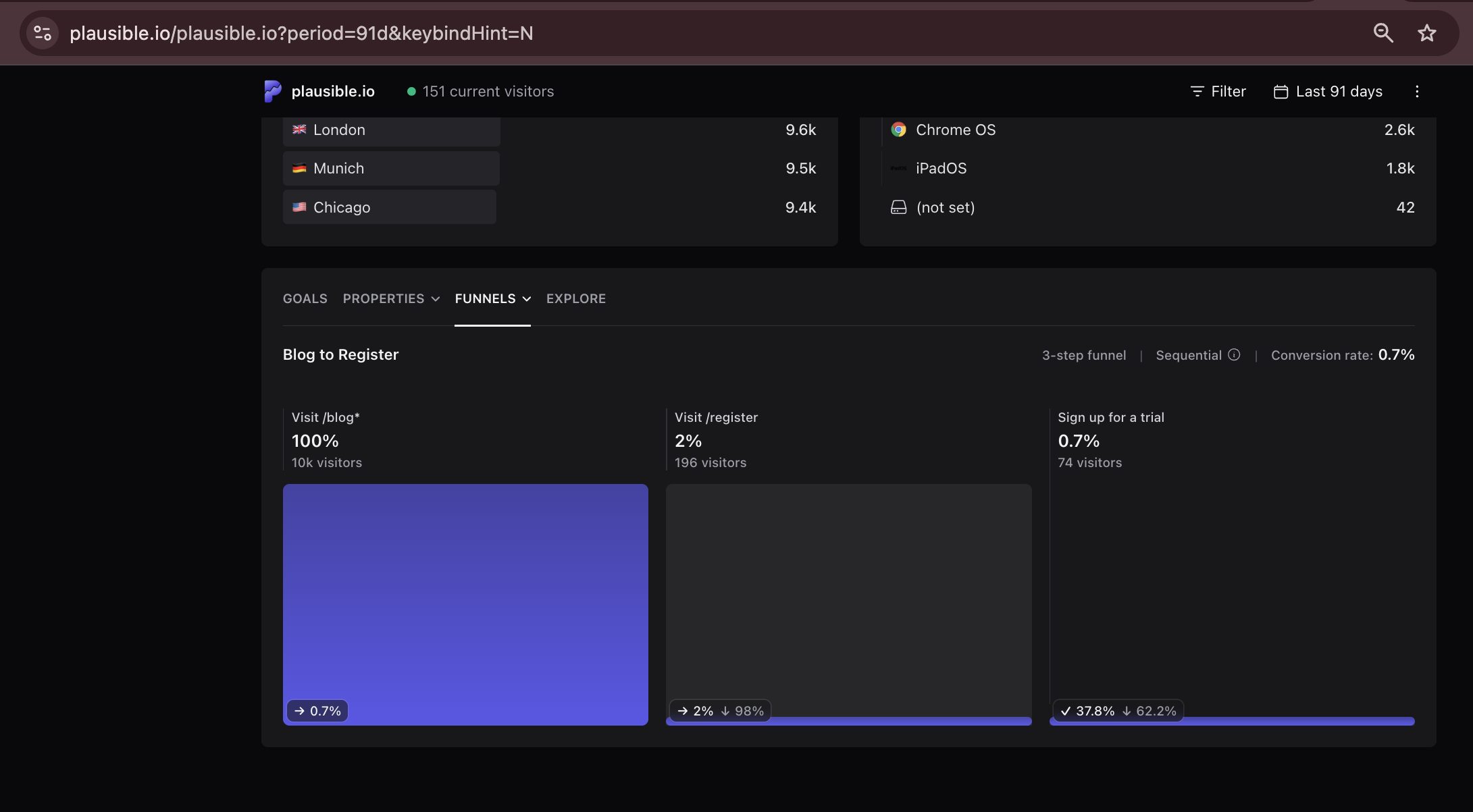
Blog to Register (3-step): Visit /blog → 10K visitors (100%) → Visit /register → 196 visitors (2%) → Sign up for a trial → 74 visitors (0.7% overall conversion).
Registration & Onboarding (4-step), a separate and much healthier funnel: Visit /register → 18.1K visitors (100%) → Sign up for a trial → 61.7% → Visit /activate → 59% → Add a site → 57% overall conversion.
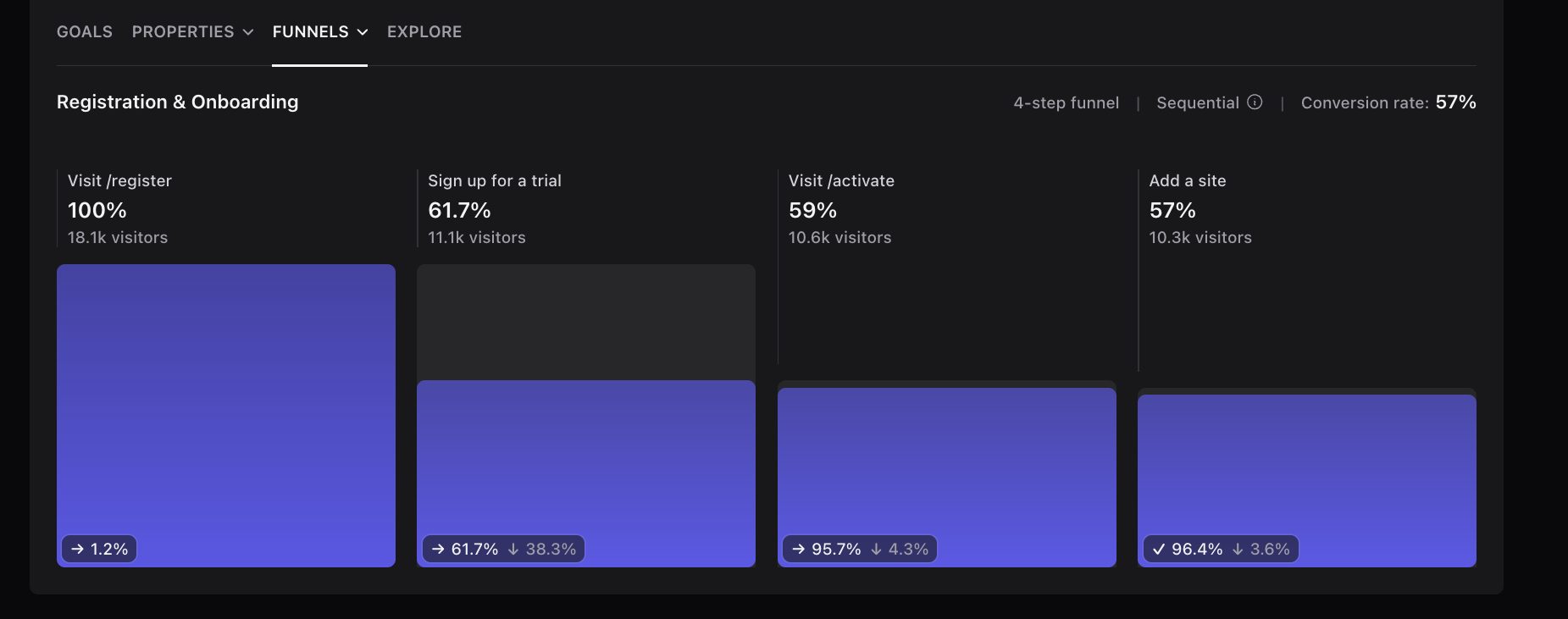
So the split is clear: getting someone from a blog post to the register page is the hard part (0.7%), but once someone reaches /register, the actual signup-to-activation flow converts well (57%). That matters for the "copy this" section; the lesson isn't "Plausible's funnel is broken," it's "content-driven visitors are cold, and that's normal; the product experience from /register onward is what's actually working."
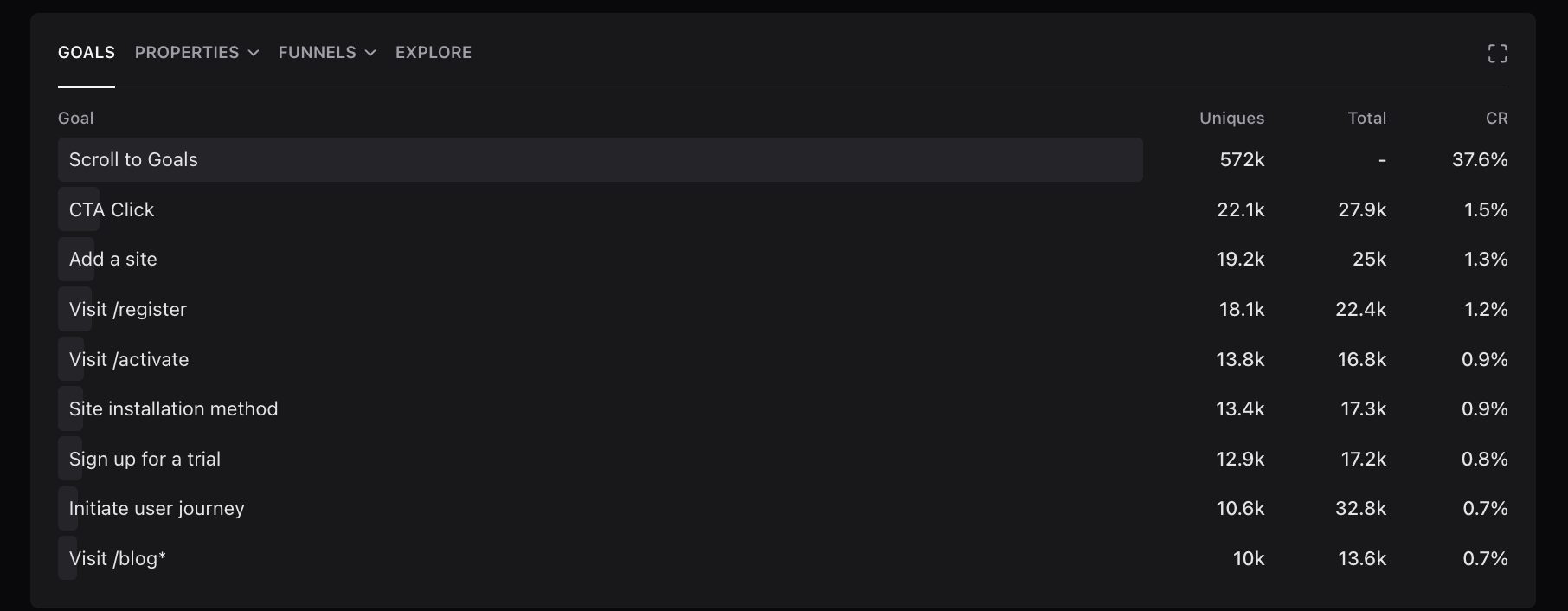
The goals table backs this up at a larger scale: 572K unique visitors scrolled to the goals section, 22.1K clicked a CTA (1.5%), 19.2K added a site (1.3%), 18.1K visited /register (1.2%), and only 10K of all of that traffic ever visited /blog at all (0.7% of total uniques), meaning the blog is a small fraction of the traffic driving these goal completions; most of the funnel starts elsewhere (likely the brand-dominant direct/homepage traffic seen earlier).
Worth noting for the record, not the main narrative: top cities are London, Munich and Chicago (9.4–9.6K visitors each), and a small but real slice of traffic comes in on Chrome OS and iPadOS. Nothing that changes the SEO story, just colour on who's actually using the dashboard demo.
The funnel is leaky despite the traffic
Blog → email newsletter: ~3,000 visits, 2 conversions in the last 30 days. Blog → register: 10K visits → 196 register visits → 74 signups, a 0.7% overall conversion (see the fuller funnel breakdown above). Despite the traffic volume, turning readers into signups is clearly hard: high content traffic hasn't translated into a high-converting funnel on these specific paths.
The "Google Analytics alternative" positioning that built the brand doesn't appear to be what's ranking the content anymore; the best-performing recent pages are broader SEO/marketing guides that only mention Plausible in passing.
Copy this with no budget
- Pick one sharp, specific pain point to write your first post about, not your product category in general.
- Publish on a fixed, sustainable cadence (twice a month beats sporadic weekly bursts that die out).
- Make at least one page radically transparent (real data, a real public dashboard, a real calculator) because that's what earns unsolicited links and shares, not the sales pages.
- Position yourself long-term around the pain point your bottom-of-funnel audience already has with your biggest competitor. Write your content as a genuine solution to that problem — you can promote your product inside it, but it has to be genuine — and stick to it consistently, long-term, rather than dumping a lot of alternative pages and playing a short-term game.
Your take: In three words: understand your audience. Know what their bottom-of-funnel pain point is, and focus your content there first, rather than spreading across everything.
Verdict
Plausible won at SEO because their content is human-written and solves a real problem, starting with Google Analytics, then privacy, open source, and transparency. That's what got them ranking for "Google Analytics alternative" early on, and it's what built their initial DR, by attacking one angle instead of spreading thin.
Now they're shifting into backlinking/SEO content for people who already found them through that keyword. It's still value-first, not just alternative pages: mostly value, with the product woven in genuinely.
My verdict: understand your audience's bottom-of-funnel pain point first. Double down on one or two angles instead of thousands of alternative pages. Once that audience is built, shift into value and transparency, that's what Plausible did, and why they're where they are.
Sources (checked Nov 5, 2026)
- seobuddy.com, "My SEO Journey: Marko Saric from Plausible.io," Feb 23, 2021
- Plausible blog, "How we built a $1M ARR open source SaaS," June 2022
- Tiny Empires Substack, "Inside a Tiny Empire: Plausible Analytics," reported late 2024, unconfirmed
- plausible.io/about, team size, funding status
- Ahrefs traffic checker (plausible.io), organic traffic, keywords, top pages
- plausible.io live public dashboard, traffic channels, top pages, funnels
- plausible.io/blog and sitemap, page counts, folder breakdown, publishing cadence
- Google SERP + AI Overview, "Google Analytics alternative" search
- founderventures.io, "Plausible sets record growth, three consecutive months," page last updated May 31, 2026
- All checked Nov 5, 2026