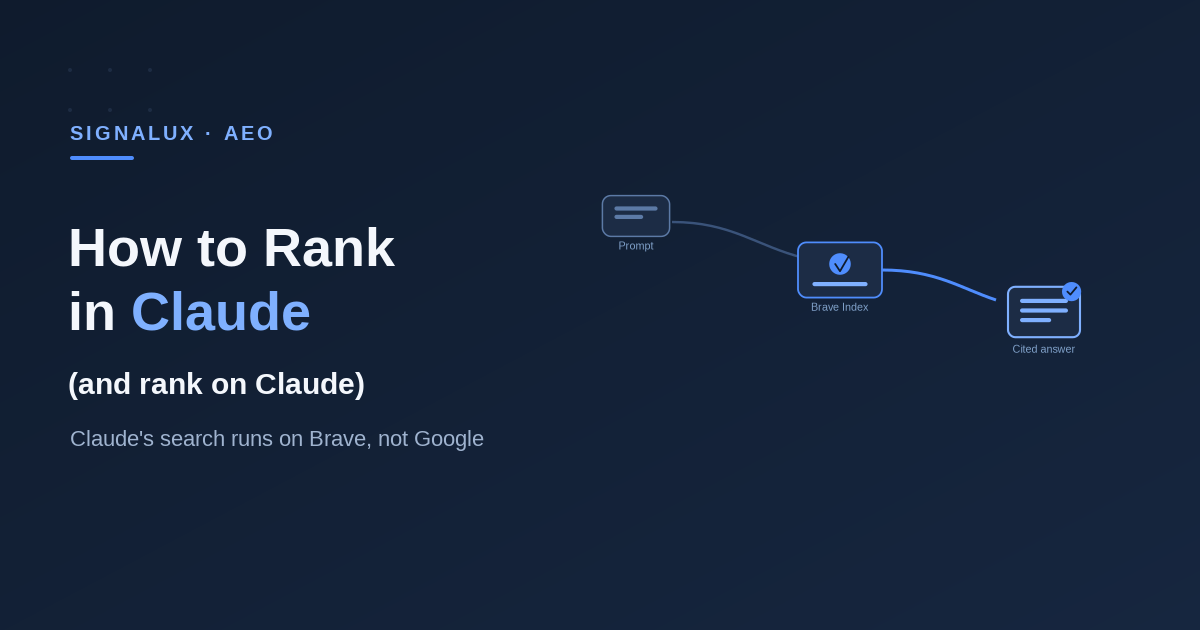
To rank in Claude, and rank on Claude's AI search, you need two things done right: get indexed by Brave Search, the engine Claude's web search actually runs on, and write pages that survive being one of a small number of sources Claude is willing to cite. A strong Google position doesn't carry over on its own.
All facts below carry the date they were checked: 26 Nov 2026.
What's in This Post
- What Does "Ranking in Claude" Actually Mean?
- How Claude Finds and Chooses Sources
- Claude, Brave, and Why Your Google Rankings Aren't Enough
- Which Anthropic Crawlers You Need to Let Through
- Check Your Firewall, Not Just Robots.txt
- Do a Brave Index Check Before Anything Else
- The Technical Checklist That Makes a Page Citable
- How to Write Pages Claude Can Actually Cite
- Build Entity Clarity So Claude Knows Who You Are
- See Claude's Brave Backend Yourself: A 2-Minute Test
- How to Know If You're Already Showing Up in Claude
- Common Mistakes That Keep Pages Out
- FAQ
This post is Claude-specific. For how the same principles play out across ChatGPT, Claude and Google AI Overviews together, see How to Rank in ChatGPT, Claude and Google AI Overviews.
What Does "Ranking in Claude" Actually Mean?
There's no results page inside Claude, so there's no position #1 to fight for. Ranking in Claude means being one of the handful of sources Claude actually names when it answers a question in your category: discovered, judged credible, quoted for a specific claim, and linked in the citation list, instead of read once and left out.
How Claude Finds and Chooses Sources
Claude doesn't search the web for every question. It answers from its training data first and only reaches for the web when the question needs something current, specific, or outside what it already knows. Anthropic's own documentation confirms Claude decides whether to search based on the prompt itself, not a toggle the user flips.
When it does search, your prompt isn't the search query. Claude rewrites a long conversational question into one or more short search strings, often running several in a row and refining them as results come back. This is documented behavior: Anthropic's docs state the search-and-read process "may repeat multiple times throughout a single request."
The five checkpoints between a question and a credit
Most pages lose their shot at step two or three, long before step five.
In the Index
Your page actually sits inside Brave's index.
Surfaced
One of Claude's rewritten queries happens to turn it up.
Trusted
Claude decides it's worth reading in full, not skimming past.
Excerpted
One specific line earns a spot inside the answer itself.
Credited
It's named in the citation list the person reading actually sees.
Reasoned from Anthropic's published web-search documentation; Anthropic hasn't published a ranking algorithm, so treat this as a model, not a confirmed pipeline. Checked 26 Nov 2026.
Claude, Brave, and Why Your Google Rankings Aren't Enough
This is the part most "Claude SEO" guides hedge as a rumor. It isn't one anymore: Anthropic's own Help Center, in its Claude for Government documentation, states plainly that the web-search connector "calls the Brave Search API," dated April 9, 2026 (Anthropic support, checked 26 Nov 2026).
That sits on top of two independent confirmations from March 2025. Brave Search was added to Anthropic's subprocessor list that month, and developer Simon Willison matched Claude's live citations to a Brave search for the same query, then found a parameter named "BraveSearchParams" inside Claude's own tool definition.
Anthropic also lists a second subprocessor, TurboPuffer, under web search. TurboPuffer is a vector and full-text search database, not a crawler, but what it actually does inside Claude's pipeline isn't publicly documented. Treat it as "also involved somehow," not "the answer."
Why this matters for you: Brave runs its own independent index of over 40 billion pages, and it doesn't mirror Google's. A page ranking #1 on Google can be absent from Brave's index entirely, and a page buried on Google can be well placed in Brave.
If you've assumed your Google SEO work carries over automatically, it doesn't. Check Brave separately.
One more thing worth knowing because it's live right now: Brave's index is also the subject of an active lawsuit. News Corp countersued Brave in July 2026, and on November 2, 2026, the New York Times and three other publishers sued over that same index and the API it sells to AI companies (checked 26 Nov 2026). Nothing about this changes what you should do today, but it's a real dependency risk sitting underneath infrastructure you're relying on.
Which Anthropic Crawlers You Need to Let Through
Anthropic runs three separate bots, and confusing them is the single most common technical mistake:
One company, three crawlers, three different outcomes
Blocking one doesn't block the others. That separation is intentional.
ClaudeBot
Gathers public pages that may feed future model training.
Block it and you opt out of training only. Your search presence doesn't move.
Your callClaude-SearchBot
Crawls specifically to keep Claude's own search index current.
Block it and Claude's search answers get both less likely to mention you and less accurate when they do.
AllowClaude-User
Steps in only when someone directly asks Claude to open or research a URL.
Block it and that direct request simply fails. Claude can't open the page at all.
AllowSource: Anthropic's crawler documentation (support.claude.com), checked 26 Nov 2026.
Check Your Firewall, Not Just Robots.txt
A lot of sites block AI crawlers at the CDN level without marketing ever knowing. Cloudflare, for one, offers a one-click "block AI bots" toggle, and some security tools have it on by default. A clean robots.txt with a locked-down WAF behind it still fails silently.
Ask whoever runs your CDN three questions:
Three questions for whoever runs your CDN
A clean robots.txt means nothing if the firewall answers first.
Do a Brave Index Check Before Anything Else
Before touching content, confirm you're even in the index Claude draws from:
- Go to search.brave.com and run
site:yourdomain.com. - Check your 10 most important URLs individually, not just the homepage.
- Use
noindexon pages you actually want excluded. A robots.txt block alone can leave a URL indexed, it just stops Brave from crawling it fresh. - Resubmit updated pages at search.brave.com/submit-url rather than waiting on a recrawl.
The claim that Brave's crawler respects the same crawl-rate limits as Googlebot shows up in a few places online. It hasn't been independently confirmed against Brave's own documentation here, so verify it yourself before repeating it.
The Technical Checklist That Makes a Page Citable
None of this is new SEO. It's the same technical foundation that helps you on Google, AI crawlers just forgive less.
Give Claude nothing to trip over
A page it can't reliably open or parse is a page it will quietly skip.
Serves cleanly, every time
No login screen, paywall, or geo-block sitting between Claude and the page.
No JavaScript gate
The facts that matter shouldn't need a script to finish running first.
A sitemap that's actually current
Resubmitted in Search Console and Bing Webmaster Tools after every change.
Nothing locked behind a click
Tables and FAQs sit in the open, not inside a tab or a load-on-click accordion.
Redirects that actually land
Skip one and a dead URL keeps getting cited for months after the fact.
Confirmed inside Brave
A quick site: search on search.brave.com for each priority URL.
- Use one canonical URL per page. Kill duplicate versions.
- Use real crawlable internal links with descriptive anchor text, not JS-only navigation.
- Keep HTTPS working and fix broken page resources.
- Don't let key pages 404 quietly. Claude may still send users to a dead URL from an old cached answer.
How to Write Pages Claude Can Actually Cite
Write short, self-contained, verifiable statements. Compare:
| Hard to cite | Easy to cite |
|---|---|
| "We offer a comprehensive, results-driven SEO solution for ambitious companies." | "Signalux is a B2B SEO and AEO agency that helps SaaS companies grow pipeline from Google and AI search." |
The second sentence survives being lifted out of context with zero surrounding text. The first doesn't. It's a claim about nothing specific.
Put the direct answer in the first 50-150 words of every priority page. Claude reads a lot of pages fast; if your intro is three paragraphs of "in today's fast-moving digital landscape," the useful sentence may never get read closely enough to be picked up. Structure every priority page the same way:
- A direct answer in the first 50-150 words
- Descriptive H2/H3 headings phrased as real questions
- A short definition or key-takeaway block
- A comparison table for alternatives, pricing, or criteria
- Step-by-step instructions for how-to content
- Original examples, screenshots, or first-hand findings
- A named, real author with a last-updated date
- Structured data where the content genuinely earns it, see what schema markup is and how to add it
Use schema markup, but don't rely on it instead of plain text. Put the actual facts in readable HTML, and let the schema reinforce it, not replace it. And write for buyer questions, not bare keywords: "how do I migrate off HubSpot" beats "HubSpot migration" as a thing to structure a page around.
Build Entity Clarity So Claude Knows Who You Are
Claude, like every retrieval-based engine, cites with more confidence when the basic facts about your company are consistent everywhere it looks:
- Company name, written the same way everywhere
- How you describe your category, in your own words, consistently
- Founder names
- Location and the markets you actually serve
- Canonical website URL
- Linked social profiles
- Clear product/service descriptions
- Public pricing model, if you share one
Inconsistency here doesn't just look sloppy. It makes you a riskier source to quote, because Claude has less confidence it's citing the right entity.
See Claude's Brave Backend Yourself: A 2-Minute Test
This is the one piece of proof in this post that's actually reproducible by you, right now, on your own account:
- Open a fresh Claude.ai chat.
- Ask Claude to describe the parameters of its own
web_searchtool. - Look for a reference to Brave in the schema it returns.
This is the exact move that originally surfaced "BraveSearchParams" back in March 2025. Anthropic may have changed what the tool schema exposes since then, so run it yourself, screenshot what you get, and note today's date next to it.
How to Know If You're Already Showing Up in Claude
There's no Search Console equivalent for Claude yet, so tracking means testing directly:
| Signal | What to look for |
|---|---|
| Brand mentions | Ask Claude your core category questions with web search on. Is your brand named at all? |
| Page citations | Which specific URL of yours, if any, gets linked? |
| Passage citations | Which sentence or stat actually got quoted, not just which page got linked? |
Run the same 5-10 questions monthly. Citations shift as Brave's index refreshes and as Claude's own behavior changes; a one-time check tells you nothing about the trend. For a broader tracking setup across engines, see Search Console's AI Overviews Report for the Google side of the same habit.
Common Mistakes That Keep Pages Out
- Assuming Google rank equals Claude visibility
- Hedging every claim ("it depends," "there are many factors"), which leaves Claude nothing concrete to quote
- Hiding the real answer behind a scroll, a tab, or three paragraphs of preamble
- Blocking AI bots at the CDN/firewall level without realizing it
- Letting old pages 404 instead of redirecting them
- Treating FAQ schema as a guaranteed citation lever rather than a plausible, cheap-to-add one, see why isn't my site cited in AI Overviews for the same failure pattern on Google's side
FAQ
How do I rank in Claude?
Get indexed by Brave Search, Claude's confirmed web-search backend, make sure Claude-SearchBot and Claude-User aren't blocked at the DNS, robots.txt, or firewall level, and write pages with a direct, self-contained answer in the first 50-150 words.
How do I rank on Claude?
Same mechanics. "Rank on Claude" and "rank in Claude" describe the same goal: being one of the handful of sources Claude cites when it answers a question in your category. There's no results page to rank on.
Does Claude use Google or Bing to search the web?
Neither. Anthropic's own Claude for Government documentation confirms Claude's web-search connector calls the Brave Search API, an independent index of over 40 billion pages.
Should I block ClaudeBot?
Only if you want to opt out of AI training specifically. Blocking ClaudeBot doesn't touch Claude-SearchBot or Claude-User, so your search visibility is unaffected.
How many sources does Claude typically cite per answer?
Estimates vary widely across independent studies, from roughly 3 to 15 depending on methodology, and none are Anthropic-published. Treat any single number you see quoted elsewhere with skepticism.
Can I see which search engine Claude is using myself?
Yes. Ask Claude directly to describe its own web_search tool parameters. This is the same technique that first surfaced Brave Search as the backend in March 2025.
Is ranking in Claude different from ranking in ChatGPT or Perplexity?
Yes. Each engine runs on different retrieval infrastructure (Claude on Brave, ChatGPT on its own evolving stack, Perplexity on its own crawler), and independent testing suggests Claude cites fewer, more specific sources than ChatGPT and shows less recency bias than Perplexity. Optimizing for one doesn't automatically optimize for the others.
The Takeaway
Ranking in Claude isn't a Google SEO problem wearing a new name, and it isn't solved by the same "get mentioned everywhere" logic that works for ChatGPT. It's two concrete jobs: get indexed by Brave Search, and write the kind of narrow, checkable, un-hedged page that survives being one of three citations instead of one of ten.
Start with the Brave index check today. It takes two minutes and tells you whether anything else in this post matters yet. For the wider version of this, covering how the same principles play out across ChatGPT, Google AI Overviews and Claude together, see How to Rank in ChatGPT, Claude and Google AI Overviews.
About the Author
Authored by Sai Teja Challapalli, founder of SignaluX, a 5+ year performance marketer who has run paid and organic programs across Meta, Google, LinkedIn, Reddit and Amazon for 30+ brands.
He writes SignaluX's SEO and AEO posts from his own day-to-day work building and marketing SaaS products, not secondhand research.
Sources (checked 26 Nov 2026)
- Anthropic, Claude for Government Help Center, confirming the web-search connector "calls the Brave Search API" (dated Apr 9, 2026): https://support.claude.com/en/articles/14503775-mcp-web-search
- Anthropic, "Does Anthropic crawl data from the web?": https://support.claude.com/en/articles/8896518-does-anthropic-crawl-data-from-the-web
- Xponent21, on Claude's web-search subprocessors (Brave, TurboPuffer): https://xponent21.com/insights/claude-web-search-brave-turbopuffer/
- Simon Willison, "Anthropic use Brave": independent test matching Claude citations to Brave Search and extracting "BraveSearchParams" (21 Mar 2025): https://simonwillison.net/2025/mar/21/anthropic-use-brave/